

If you’re a local service-based business owner planning a new website, one of the first questions you’ll probably ask is: “How many pages am I supposed to have?”
And honestly, most businesses are overthinking it. Many business owners assume they need a huge website with dozens of pages and endless content to look professional online. But in reality, most service-based businesses need a clear, strategic website with a few key pages.
Pages Every Professional Website Needs
A strong website is less about having the most pages and more about having the right pages. For most service-based businesses, a well-organized website with clear information and intentional structure will almost always perform (and convert) better than an overly complicated site filled with unnecessary pages.
Whether you’re a contractor, consultant, landscaper, photographer, or another local service provider, these are the core pages every professional website should include.
Homepage
Credit: Clearview Real Estate
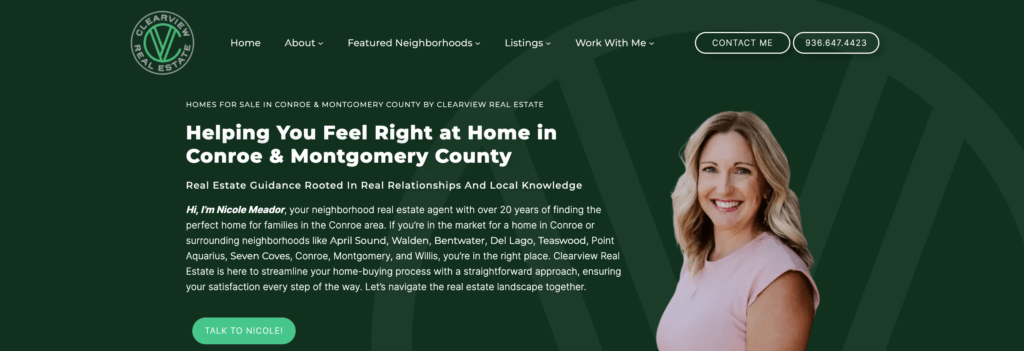
Your homepage is often the first impression someone has of your business, so clarity and overall design matter. A lot. In fact, research discussed by SolidPixels Academy found that visitors form an opinion about a website in as little as 0.05 seconds. That means your homepage needs to quickly communicate who you are, what you do, where you work, and how visitors can take the next step (and what that next step is!).
A strong homepage should balance both user experience and SEO. According to the Michigan Technological University SEO Guide, organized website structure and well-optimized content help search engines better understand your website and improve visibility in search results.
A strong homepage should include:
- Clear navigation
- Mobile-friendly design
- Straightforward messaging
- Strong calls-to-action
- Easy access to important pages like services and contact information
- Trust-building elements like reviews or testimonials
Your homepage should also help guide visitors naturally through the rest of your website instead of overwhelming them with too much information all at once. Simple layouts and intentional page structure often create a much better user experience than cluttered homepages trying to say everything at once.
About
Your About page is where your website starts to feel more personal. For service-based businesses especially, people usually want to know who they’re hiring before they ever fill out a contact form or pick up the phone.
A strong About page helps build trust, credibility, and connection. According to Business.com, About pages give businesses an opportunity to communicate their story, explain their experience, and help potential customers feel more connected to the brand.
Your About page doesn’t need to feel overly corporate or formal. In fact, for many local businesses, a more conversational and approachable About page often creates a better user experience.
A strong About page may include:
- Your business story
- Experience or qualifications
- Photos of you or your team
- Your values or approach
- What makes your business different
- Local ties to your community
- Testimonials or reviews as social proof (if you’re not reserving a separate page for them)
For many service-based businesses, the About page is one of the pages most likely to turn a visitor into a lead because it helps people feel more comfortable and confident about reaching out.
Contact
Your Contact page should make taking the next step feel easy. If visitors have to hunt for your phone number, search through multiple pages, or struggle with a confusing form, there’s a good chance they’ll leave the website altogether.
According to the Nielsen Norman Group, users prefer websites that reduce friction and make it easy to complete their goals. That means your Contact page should be simple, straightforward, and accessible from anywhere on your website.
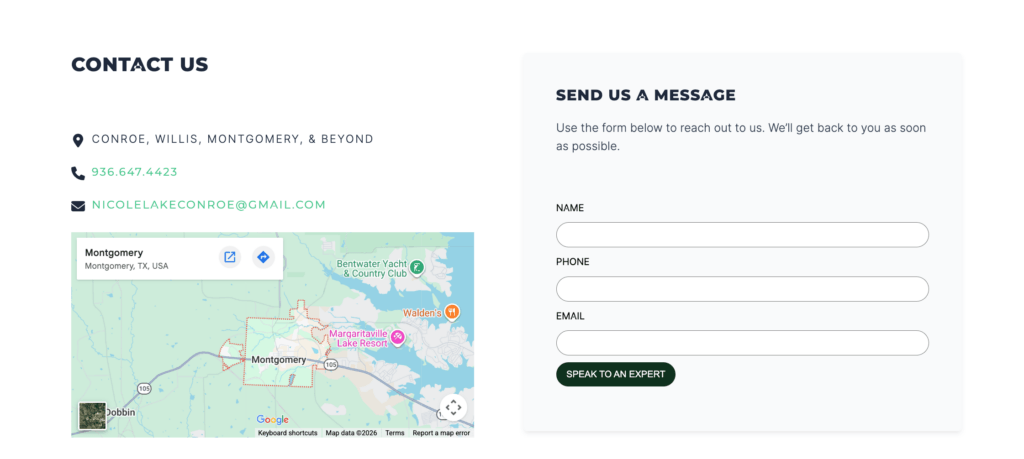
A strong Contact page should include:
- Phone number
- Email address
- Contact form
- Business hours
- Service area information
- Links to social media profiles (if applicable)
- A clear call-to-action
Credit: Clearview Real Estate
For local businesses, it’s also important that your contact information remains consistent across your website, your Google Business Profile, and other online directories. Consistent business information helps improve trust with customers and can support local SEO efforts.
Services
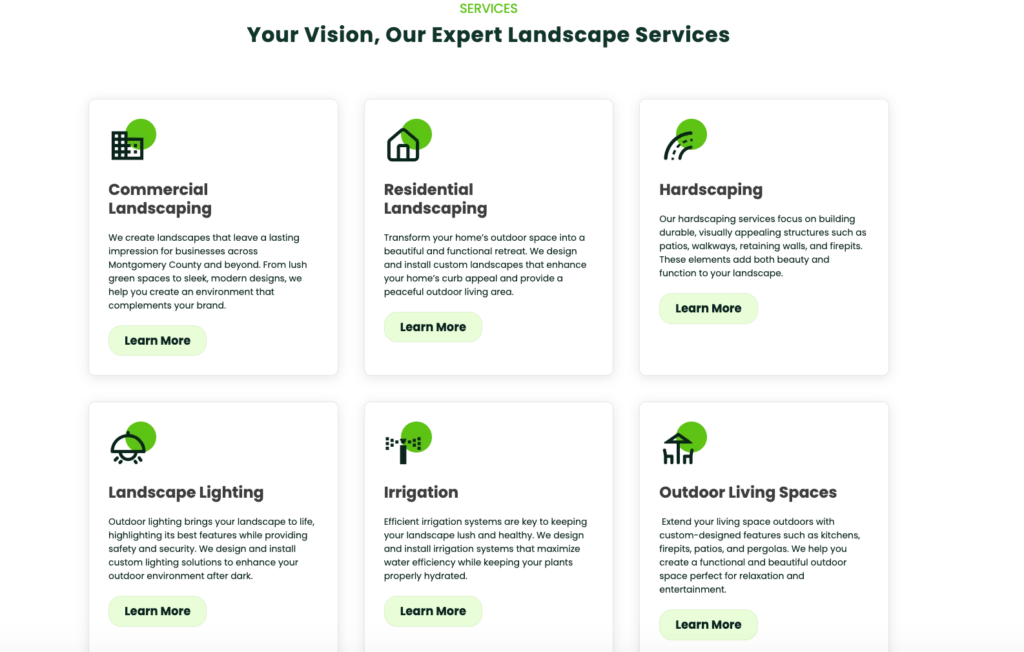
Your Services page is where you clearly explain what you do and who you help. While your homepage may provide a quick overview, your Services page allows visitors to explore your offerings in more detail and determine whether your business is the right fit for their needs.
Credit: C4 Landscape & Design
Depending on your business, you may have a single Services page or separate pages for each service you provide. Dedicated service pages often create better user experiences while also providing additional opportunities to target relevant keywords in search results.
A strong Services page should include:
- Clear descriptions of each service
- Benefits and outcomes for customers
- Frequently asked questions
- Service area information
- Calls-to-action that encourage visitors to contact you
- Internal links to related content
The goal isn’t to overwhelm visitors with information. Instead, focus on answering common questions and helping potential customers feel confident about taking the next step.
Other Pages for Local Businesses to Consider
Not every business needs the exact same website structure. Depending on your industry and goals, there may be additional pages that help strengthen trust, improve SEO, or support conversions.
Portfolio/Testimonials
For many local businesses, trust plays a huge role in whether someone decides to reach out.
Portfolio pages, galleries, testimonials, and case studies can help potential customers feel more confident about working with you. This is especially helpful for visually driven or highly competitive industries like landscaping, real estate, photography, design, construction, and home services.
Examples of helpful content include:
- Before-and-after photos
- Client testimonials
- Google reviews
- Project galleries
- Case studies
- Client success stories
These pages help visitors visualize the quality of your work before making a decision.
Blog
A blog is one of the best ways to continuously improve your website’s SEO while also creating helpful content for potential customers.
According to HubSpot, businesses that consistently publish helpful blog content often improve their search visibility, generate more website traffic, and create more opportunities to connect with potential customers online.
For local service-based businesses, blogs can help answer common questions, target local keywords, and support long-term visibility in Google search results. For example, a landscaper may write about low maintenance landscaping ideas for Texas summers, while a photographer may create blogs about planning family photo sessions or wedding timelines.
Blog content can also support:
- SERP Rankings
- Brand visibility
- Internal linking opportunities
- Keyword targeting
- Website authority
- Helpful user experiences
- AI and Google search visibility
Over time, blog content helps create a stronger digital presence while giving potential customers more ways to discover your business online.
Stress-Free Professional Website Design in Montgomery County, TX
At Trulove Webworks, we believe small businesses deserve websites that are both professional and practical. That’s why we created Stress-Free Websites. Stress-Free Websites is a streamlined custom website design solution built specifically for local service-based businesses.
Instead of overwhelming business owners with endless decisions, complicated processes, and expensive custom development, our team focuses on creating strategic websites that are designed to attract visitors, build trust, and generate leads.
Every Stress-Free Website includes the essential pages your business needs, mobile-friendly design, SEO best practices, clear calls-to-action, and a structure built to support long-term growth. Whether you’re launching your first website or replacing an outdated one, we’ll guide you through the process from start to finish.
The result is a professional website that looks great, functions smoothly, and helps your business make a strong first impression online (without the stress or the extreme cost of typical custom website design services).
Build a Website That Works for Your Montgomery County Business
Business websites should always prioritize clear navigation, helpful information, and a user-friendly experience.
Whether you’re starting from scratch or considering a redesign, focusing on the core pages your visitors actually need will create a stronger foundation for long-term success. If you’re looking for professional website design services in Montgomery County, TX, the team at Trulove Webworks is here to help create a website that works as hard as you do.
If you’re ready for a website that’s professional, strategic, and designed to support your business goals, we can help. Our Stress-Free Websites are built specifically for local service-based businesses, making it easier to establish a strong online presence without the overwhelm. Contact us today to learn more about our professional website design services in Montgomery County, TX.
Love it? Share it!

About The Author
I'm KT and I'm the face behind Trulove Webworks. I live in Montgomery, TX with my husband and 3 beautiful daughters. I love design and business strategy but the real reason I do what I do is because I want to see more small businesses thrive.
- Katelyn Trulove
Related Posts

Is Your Website Even Visible in Google’s AI Overviews? Here’s How to Find Out
Katelyn Trulove | September 18, 2026
Quick question: when someone searches for a business like yours on Google, are you actually showing up? Not “are you ranking on page one” — that’s the old question. The new question is whether you’re showing up in the AI-generated summary that now appears at the top of most Google searches, before anyone even scrolls…

What Are AI Overviews? A Plain-English Guide for Local Business Owners
Katelyn Trulove | September 16, 2026
If you’ve noticed Google’s search results look a little different lately — a summary box sitting above the usual list of links — you’re not imagining things. That’s called an AI Overview, and it’s become one of the biggest changes to how Google works in years. We talk to a lot of business owners who’ve…

5 Signs Your Website Isn’t Ready for AI-Powered Search
Katelyn Trulove | September 16, 2026
Search has changed fast this year. AI Overviews — the AI-generated summaries now sitting above traditional Google results — reach over 2.5 billion people a month, according to Dataconomy, and Search Engine Land reports that zero-click searches (where someone gets their answer without clicking any website at all) are now as high as 68% of…

Why Authentic Content Is Becoming Your Best Search Visibility Strategy
Katelyn Trulove | September 16, 2026
Google just rolled out another spam update aimed at AI-generated and mass-produced content. Nextdoor just rolled out verified business pages built to be a lot harder to fake than your typical review platform. Two different companies, two different products, but they’re both pointing at the same thing: the platforms your customers use every day are…

How to Write Content That Actually Sounds Like You
Katelyn Trulove | September 16, 2026
We recently wrote about why authentic content is becoming your best search visibility strategy — the short version is that Google’s latest spam update specifically targets mass-produced, AI-stuffed content, and rewards the businesses saying real, useful things about what they actually do. Great, but “be authentic” isn’t exactly a to-do list. So here’s what that…
Where Your Customers Are Really Looking: A Local Trust Checklist
Katelyn Trulove | September 16, 2026
You could have the best website in Montgomery County, and still lose a customer before they ever click on it. In our last post, we talked about why authentic content is winning right now, both with Google and with real customers. But your website is only one stop on a much longer customer journey. Before…

Local Web Design & SEO Companies Near Montgomery, TX: A 2026 Comparison
Katelyn Trulove | September 15, 2026
If you’ve searched “web design near me” or “SEO company Montgomery TX,” you’ve probably noticed the same problem we ran into: most of what shows up isn’t actually local. It’s a national company that generates a landing page for every city in the country, purely to rank for that search. We wanted an honest answer…

AI Overviews and Accessibility Lawsuits: What They Have in Common (and What They Mean for Your Website)
Katelyn Trulove | September 15, 2026
Two things happened this year that, on the surface, don’t seem related at all. Google quietly gave every website owner a new way to see how often they’re showing up in AI Overviews — the AI-generated summaries that now sit at the top of a lot of Google searches. And in the world of website…

Is Your Cookie Banner Actually Doing Its Job?
Katelyn Trulove | September 15, 2026
If you’ve clicked “Accept” on a cookie banner today without reading it, you’re not alone — most people do the same thing. But that little popup that shows up the moment someone lands on your website is doing more (or less) than you might think. It can be a genuine accessibility barrier, a privacy-law gap,…

Google Business Profile Clicks Are Down. Does That Mean Your Local SEO Isn’t Working?
Katelyn Trulove | September 15, 2026
If you’ve looked at your Google Business Profile performance recently and noticed fewer website clicks or calls, it’s easy to assume something is wrong. But new 2026 data suggests there may be a bigger shift happening in how people use Google to find and choose local businesses. According to Q2 2026 Google Business Profile data…


Serving Montgomery, TX, Magnolia, TX, Conroe, TX, Tomball, TX, The Woodlands, and all of The Greater Houston Area
832-349-4231
© Trulove Webworks 2024